Rewilding with Wild Bosky - Articles, News & Events

Rewilding with Wild Bosky - Articles, News & Events

Beneflore™ Super Soil: How to Rewild Your Soil

by Anton Pearce on Sep 02 2026
Open a fresh bag of Beneflore™ and the first thing we hope you notice is that it looks, feels and smells like rich living earth. That is deliberate. Beneflore isn’t a conventional fertiliser and it isn’t intended to turn Western Australian sand into rich vegetable-garden loam. It is a concentrated planting-hole amendment designed around a different idea: when we put native plants back into a disturbed landscape, we should also begin rebuilding the living soil beneath them. That is what we mean by: Rewild your soil. Rewilding is more than revegetation Planting locally appropriate native species is an important part of restoring a landscape. But an intact ecosystem is much more than the plants we can see. Above ground there are insects, birds and other animals using plants for food, shelter and reproduction. Below ground there is another extraordinary ecosystem made up of bacteria, fungi, microscopic organisms, roots and invertebrates. And healthy soil doesn’t contain only the organisms alive at this particular moment. It contains the accumulated remnants of life that came before them. Decaying roots and leaves. Humus. Carbon. Worm castings. Insect frass and fragments of exoskeleton. Microbial residues. All of this material is continually processed, consumed and recycled into another generation of life. Where land has been cleared and repeatedly disturbed, we can lose both the living community and much of that accumulated biological inheritance. Beneflore cannot recreate an untouched ecosystem in a bag. But it can help return some of the ingredients, organisms and conditions that a functioning landscape would ordinarily have been building for itself. It is one small way of beginning to make good what has been stripped away. What’s inside Beneflore? Beneflore is made in small batches from deliberately selected ingredients. The exact formulation is ours, but we’re proud of what goes into it. Premium mature composts Compost forms the heart of Beneflore. Good mature compost contains transformed plant material, stable organic matter, humus, nutrients and a diverse microbial community. Rather than simply feeding the plant with soluble fertiliser, compost provides organic matter from which a functioning soil system can continue cycling nutrients. Hydrophil™ — biochar, WA spongolite and kaolin clay Beneflore contains our concentrated Hydrophil™ soil matrix. Hydrophil combines porous biochar, Western Australian spongolite and kaolin clay to help the root zone retain water and nutrients while creating long-lasting physical habitat for soil organisms. Biochar provides persistent porous carbon. Spongolite provides porous mineral structure and silica. Kaolin adds the fine mineral surfaces largely absent from many sandy WA soils. Beneflore therefore combines a living organic component with a persistent mineral-and-carbon framework. Worm castings Worm castings are organic matter that has already passed through one of nature’s great soil-processing systems. They contribute biologically transformed organic matter, microorganisms and fine humus-rich material. They are also part of the broader story of healthy soil: life consuming, transforming and returning biological material back into the system. Black soldier fly frass Our insect frass brings another pathway from the natural decomposer cycle into Beneflore. It contains the castings and biological remnants associated with black soldier fly larvae, including chitinous material from insect bodies and exoskeletons. That matters to us for more than simply its nutrient value. In functioning ecosystems, insects are not separate from soil formation. They consume biological material and eventually return their own residues to the system. Frass helps bring some of that missing complexity back. Kelp meal Kelp contributes complex naturally derived organic compounds and trace constituents. We use it in modest amounts as part of the diverse food supply available to the living community within Beneflore, rather than as a heavy fertiliser. Beneficial microbes and mycorrhizal fungi Beneflore contains additional beneficial bacteria and fungi, including mycorrhizal propagules. Mycorrhizal fungi form relationships with living roots, extending the effective reach of the root system into surrounding soil. Not every organism placed in a bag will necessarily establish around every plant. Soil biology is far more complicated than that. Our aim is to provide diversity, habitat and food, then allow the developing root system and local environment to determine what flourishes. Gentle nutrition — not a high-powered fertiliser Beneflore contains nutrients because compost, worm castings, insect frass, kelp and living biological materials naturally contain nutrients. But we have deliberately avoided turning Beneflore into a heavily fertilised supersoil. Many Western Australian native plants evolved in relatively nutrient-poor environments, and excessive fertiliser—particularly phosphorus—can be harmful to some species. Our philosophy is: Feed the soil first. Feed the plant later, if it needs it. Beneflore is intended to support strong establishment through better soil function, organic matter, microbial activity and gentle background nutrition. You do not need to add fertiliser to the planting hole simply because you are using Beneflore. Later, once the plant is establishing and actively growing, additional native-suitable nutrition may be beneficial depending on the species and soil. At Wild Bosky we commonly use products such as Neutrog Bush Tucker and Neutrog Seamungus, both of which we sell. These can be used later as gentle supplementary feeds rather than being loaded into the planting hole from day one. How to use Beneflore Beneflore is a planting-hole amendment. You do not need to spread it by the square metre or replace all the soil around your plant. Instead, concentrate it where your new roots will begin growing. Our starting recommendation is: Mix approximately 1 part Beneflore with 2–3 parts of the existing soil used to backfill the planting hole. The exact quantity depends on the size of the plant and how much loose soil is actually required around its root ball. For small forestry-tube plants, this may only be a relatively small handful or scoop of Beneflore. For larger plants, use proportionally more. The important principles are: dig an appropriately sized planting hole; retain the existing soil; mix Beneflore thoroughly through the loose backfill soil; do not put a concentrated layer of Beneflore directly underneath the root ball; position the plant at the correct depth; gently firm the amended soil around it; water thoroughly. We are continuing to refine our exact scoop recommendations through real planting trials. If your bag includes a current dose guide, follow that guide. Watering still matters Beneflore creates a better environment for a young root system, but it cannot substitute for establishment watering. This is particularly important with nursery-grown natives. The root ball initially occupies only a small volume of soil. Until roots begin growing well beyond it, the plant can dry surprisingly quickly even when the surrounding landscape looks moist. When planting: Water deeply immediately after planting. Make sure the original root ball itself becomes wet, not just the soil around it. Continue checking the plant regularly through its establishment period. There is no universal watering schedule because conditions vary enormously with season, species, soil, wind, temperature and exposure. Aim for thorough watering followed by appropriate drying rather than permanently saturated soil. As the root system expands, gradually move toward deeper and less frequent watering appropriate to the plant. Beneflore and Hydrophil can help make that water go further. They cannot replace the gardener during establishment. Beneflore is alive Unlike a bag of mineral amendment, Beneflore contains moist organic material and living biology. That is one of the things we value about it. It also means Beneflore should be treated more like a fresh biological product than an indefinitely shelf-stable fertiliser. We manufacture it in relatively small batches and recommend: store it somewhere cool and shaded; keep the bag closed when not in use; avoid leaving it in a hot car or direct sun; use it within the best-before period printed on the pack; once opened, use it reasonably promptly. A fresh bag should smell pleasantly earthy—like good compost, humus or forest-floor soil. If a product ever develops a strongly sour, rotten, ammonia-like or putrid smell, we would not recommend using it around a valuable plant. What is Hydrophil™? You don’t need Hydrophil separately in order to use Beneflore—Beneflore already contains it. But the two products serve somewhat different purposes. Hydrophil™ is our highly concentrated planting-hole amendment built around biochar, WA spongolite and kaolin clay. It focuses principally on water movement, water and nutrient retention, and durable microbial habitat. Beneflore™ takes those physical foundations and surrounds them with mature compost, worm castings, insect frass, kelp and living biology. So if you want a tiny, highly concentrated amendment with excellent storage and very low application rates, Hydrophil may be all you need. If the soil is badly depleted and you want to introduce organic matter and living-soil complexity as well, Beneflore is the fuller treatment. Some gardeners may choose to use Hydrophil alone in relatively intact soil and reserve Beneflore for the hardest, most biologically depleted planting sites. Both products come from the same Wild Bosky idea: a native plant should not simply survive the planting hole. It should begin rebuilding a living landscape around itself. Above ground, we plant habitat. Below ground, we begin restoring the soil that makes habitat possible. Beneflore™ Super Soil — Rewild your soil.

Rewilding with Wild Bosky - Articles, News & Events

Hydrophil™: How to Use Your Planting-Hole Amendment

by Anton Pearce on Sep 02 2026
If you’ve bought Hydrophil™, you’re probably planting into the kind of soil we know very well in Western Australia: sandy, fast-draining, often water-repellent and not especially good at holding onto nutrients. Hydrophil was developed to help change what happens in the small but critically important zone around a newly planted root system. It isn’t a conventional fertiliser, compost or synthetic water crystal. Hydrophil is a concentrated planting-hole amendment made from a carefully balanced blend of carbon and mineral ingredients designed to help the soil accept water, retain moisture and nutrients, and provide better habitat for soil biology. A little goes a long way. Why use Hydrophil when planting? A newly planted native has a difficult transition to make. In the nursery, its roots have been growing in a carefully managed potting mix with regular water. Once planted into the ground, those roots suddenly encounter the realities of the landscape around them. In much of Perth and south-west Western Australia that can mean coarse sand, rapid drainage, poor nutrient-holding capacity and soil that becomes difficult to re-wet once dry. Hydrophil is designed to improve that immediate root zone at the time when the plant is most vulnerable. Rather than replacing the existing soil, we mix a small amount of Hydrophil through it. The aim is to make the soil around the new root ball work better. What’s inside Hydrophil? The exact formulation and proportions are proprietary, but the important ingredients aren’t a secret. Biochar Biochar is a highly porous, stable form of carbon. Its microscopic internal structure creates an enormous surface area capable of retaining water and nutrients while also providing protected habitat for soil microorganisms. Unlike organic matter that decomposes relatively quickly, biochar can remain in soil for a very long time. Our biochar is lightly conditioned during manufacture so that it begins life in the soil as a useful reservoir rather than simply an empty piece of carbon. WA spongolite Spongolite is an unusual naturally porous mineral formed from the microscopic silica skeletons of ancient marine sponges. Our spongolite is sourced in Western Australia. Its porous structure helps hold moisture within the soil while contributing mineral diversity and silicon. Together, spongolite and biochar give Hydrophil two very different kinds of microscopic pore space: one mineral and one carbon-based. Kaolin clay Many of our poorest garden soils contain plenty of sand but very little clay. Even a relatively small clay component can make an important difference to how soil holds water and nutrients. Kaolin contributes fine mineral particles and exchange surfaces that complement the larger pore structures of the biochar and spongolite. A small amount of professional soil wetter Hydrophil also contains a carefully controlled amount of granulated soil wetter. This has a different job from the other ingredients. The wetting agent helps the first irrigations penetrate dry or water-repellent soil. Over time its effect diminishes, while the biochar, spongolite and clay remain behind as the longer-lasting soil matrix. How to use Hydrophil Hydrophil is intended as a planting-hole amendment, not something you need to spread across the entire garden. For forestry tube plants Use approximately: 1 level tablespoon of Hydrophil per plant. Dig your planting hole, then mix the Hydrophil thoroughly through the loose soil that will be used to backfill around the root ball. Do not leave Hydrophil as a concentrated layer underneath the plant. Plant normally, gently firm the soil and water thoroughly. For larger plants For plants in approximately 140 mm pots, use around: 3 level tablespoons per plant. Again, mix it thoroughly through the planting-hole backfill rather than placing it in one concentrated pocket. Larger root balls and planting holes may justify proportionally more. Hydrophil doesn’t replace watering This is important. Hydrophil can help soil accept and retain water, but it cannot make a newly planted native drought-proof. Until new roots have grown beyond the original root ball and into the surrounding soil, the plant still depends heavily on you. Immediately after planting, give the plant a thorough deep watering that wets both the original root ball and the surrounding amended soil. Continue checking it regularly during establishment. How often you need to water will depend on species, weather, season, soil and exposure. Hot weather and drying winds can dramatically increase demand. The goal is not constantly wet soil. The goal is to avoid allowing the young root system to become severely dry while it is establishing. As the plant develops a larger root system, you can progressively move toward deeper and less frequent watering appropriate for the species. Does Hydrophil contain fertiliser? Hydrophil is not designed as a fertiliser. There is a very small nutrient component associated with the conditioning process, but its purpose is primarily to prepare the biochar rather than feed the plant. We prefer this approach because different native plants have different nutrient needs, and many Australian species are adapted to relatively low-fertility soils. Hydrophil’s job is to help the soil hold and use resources more effectively. If your plant requires additional nutrition later, we favour gentle native-suitable feeding rather than adding large amounts of fertiliser to the planting hole. For established plants we commonly use products such as Neutrog Bush Tucker and Neutrog Seamungus, both available from Wild Bosky. These can be introduced later as required; they are not necessary simply because you have used Hydrophil. Rewilding starts below the ground too Wild Bosky is about more than putting native plants back into landscapes. When vegetation is cleared and soil is repeatedly disturbed, we lose more than the plants visible above ground. We also disrupt the enormous living community beneath them and gradually remove much of the biological inheritance that an intact landscape continually builds for itself. Healthy soils contain roots, fungi, microbes, organic residues, mineral particles and the accumulated remains of previous generations of life. We cannot recreate an undisturbed ecosystem by adding something from a bag. What we can do is make the environment around a new plant more hospitable to life. Hydrophil helps provide some of the physical foundations: water, nutrient-holding capacity, carbon, minerals and microbial habitat. Then the plant begins doing the rest. New roots grow. Root exudates feed microorganisms. Leaves eventually fall. Fungi establish. Insects arrive. Organic matter accumulates. The landscape slowly starts building soil again. That is what we mean when we talk about rewilding above and below the ground. Want to go further? Meet Beneflore™ Hydrophil concentrates on the physical foundations of the root zone. For degraded soils that also need an infusion of organic matter and living biology, we created Beneflore™ Super Soil. Beneflore combines premium mature composts with Hydrophil™, worm castings, black soldier fly frass, kelp and beneficial microbes. Think of Hydrophil as helping build the habitat. Beneflore brings more of the living soil ecosystem with it. Both are designed as concentrated planting-hole amendments, so you can improve the soil where your new plant actually needs it rather than moving large quantities of soil improver around the garden. Hydrophil™ — build a better root zone from the day you plant.

Rewilding with Wild Bosky - Articles, News & Events

Your Birds & Bees Bundle: A Guide to Your WA Native Plants

by Anton Pearce on Aug 27 2026
Your Birds & Bees Bundle is designed to create a small patch of living habitat using diverse WA native flowering plants. This guide explains each plant in your bundle, including its mature size, flowering season, preferred growing conditions and the role it can play in attracting birds, native bees, butterflies and other beneficial insects.

Rewilding with Wild Bosky - Articles, News & Events

Your Screening Bundle: A Guide to Your WA Native Plants

by Anton Pearce on Aug 27 2026
Your Screening Bundle is designed to grow into a layered mix of WA native shrubs and small trees for privacy, wind protection and wildlife habitat. This guide explains each plant in the bundle, including its mature size, preferred growing conditions, flowering season, habitat value and where it fits within the finished screen.
Plant Now, While It Rains: Why Winter Is the Best Time to Establish WA Natives

Rewilding with Wild Bosky - Articles, News & Events

Plant Now, While It Rains: Why Winter Is the Best Time to Establish WA Natives

by Anton Pearce on Jun 24 2026
In the Perth Hills, winter is the best time to plant WA natives. While the soil's cool and damp, they grow the deep roots that carry them through summer — and the winter rain does the watering for you. Here's why now is the moment to get them in the ground.
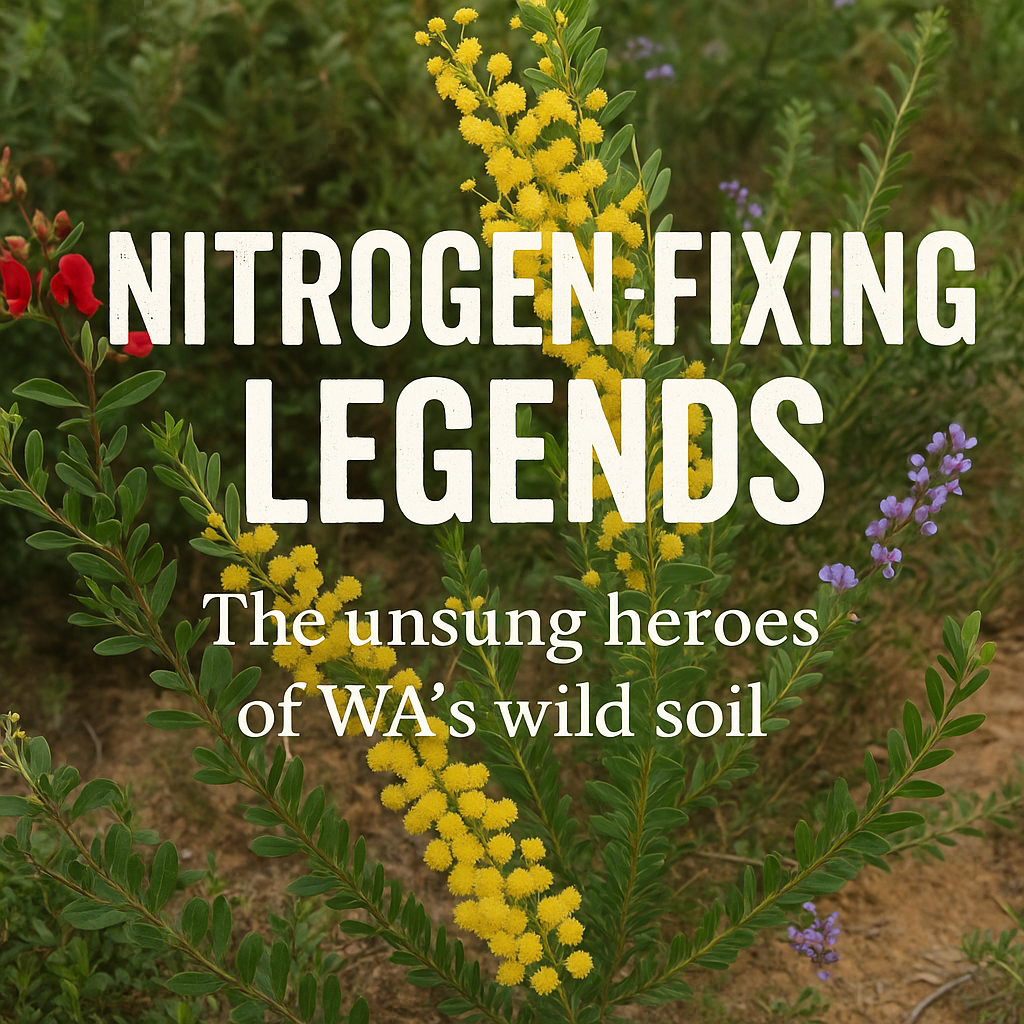
Nitrogen-Fixing Legends: The Unsung Heroes of WA’s Wild Soil

Rewilding with Wild Bosky - Articles, News & Events

Nitrogen-Fixing Legends: The Unsung Heroes of WA’s Wild Soil

by Anton Pearce on Jul 02 2025
Let’s talk dirt. WA soils — especially in our coastal and inland regions — are not exactly what you’d call “nutrient-rich.” In fact, a lot of it is basically ancient beach sand that’s been sitting around for millions of years doing sweet bugger all in the fertility department. That’s where nature pulls out one of its party tricks. Enter: nitrogen-fixing native plants. These plants are absolute legends. They don’t just survive in tough soils — they improve them. They don’t wait around hoping someone will feed them. They go out, strike a deal with microbes, and make their own bloody fertiliser. So what’s going on? Nitrogen is essential for plant growth. It helps build proteins, enzymes, chlorophyll — all the good stuff. But most of the nitrogen in the air (and there’s loads of it) is locked up in a form that plants can’t use. It’s like being in the middle of the ocean and dying of thirst. Nitrogen-fixing plants — like many wattles (Acacia), Kennedia, Hardenbergia, Daviesia, and Jacksonia — solve this with a brilliant underground alliance. Their roots form these tiny nodules, and inside those nodules live special bacteria (usually Rhizobium or Bradyrhizobium). These microbes have one job: convert atmospheric nitrogen into a plant-usable form. It’s called nitrogen fixation, and it’s kind of miraculous. In return, the plant feeds the microbes a steady diet of sugars produced through photosynthesis. It’s not a charity — it’s a trade deal. A deep, ancient partnership that’s been going on for millions of years. No contracts, no invoices. Just mutual benefit and trust. What’s even more awesome is that these plants don’t keep the goodness to themselves. Over time, they enrich the soil. When leaves drop, roots die back, or plants decompose, they release nitrogen into the soil — and nearby plants reap the rewards. So when you see a little tough-as-nails wattle battling away in sandy ground, know that it’s also a soil builder, laying the foundation for a whole ecosystem. Want to regenerate a patch of dead-looking land? Get some nitrogen-fixing natives in the mix. They stabilise the soil, boost fertility, and often host pollinators and other beneficial bugs. Some even double as fodder, shelter, or groundcover. They’re nature’s slow-release fertiliser, but with flowers. At Wild Bosky, we get a bit giddy about this stuff. Because what might look like scrubby bush to some is actually a high-functioning underground economy — roots trading with microbes, improving the landscape one node at a time. This is the kind of resilience we want to champion. Not just plants that grow — but plants that give back. If you’re planting for a better future — for your garden, your bush block, or the broader land — don’t forget these humble legends. They’re not flashy. But they’re clever. Tough. Generous. And totally badass. Stick around long enough and you’ll see how they quietly turn even the crappiest dirt into something teeming with life. And that, to us, is pure wild magic.