Products
96 products
Sort by:
96 products


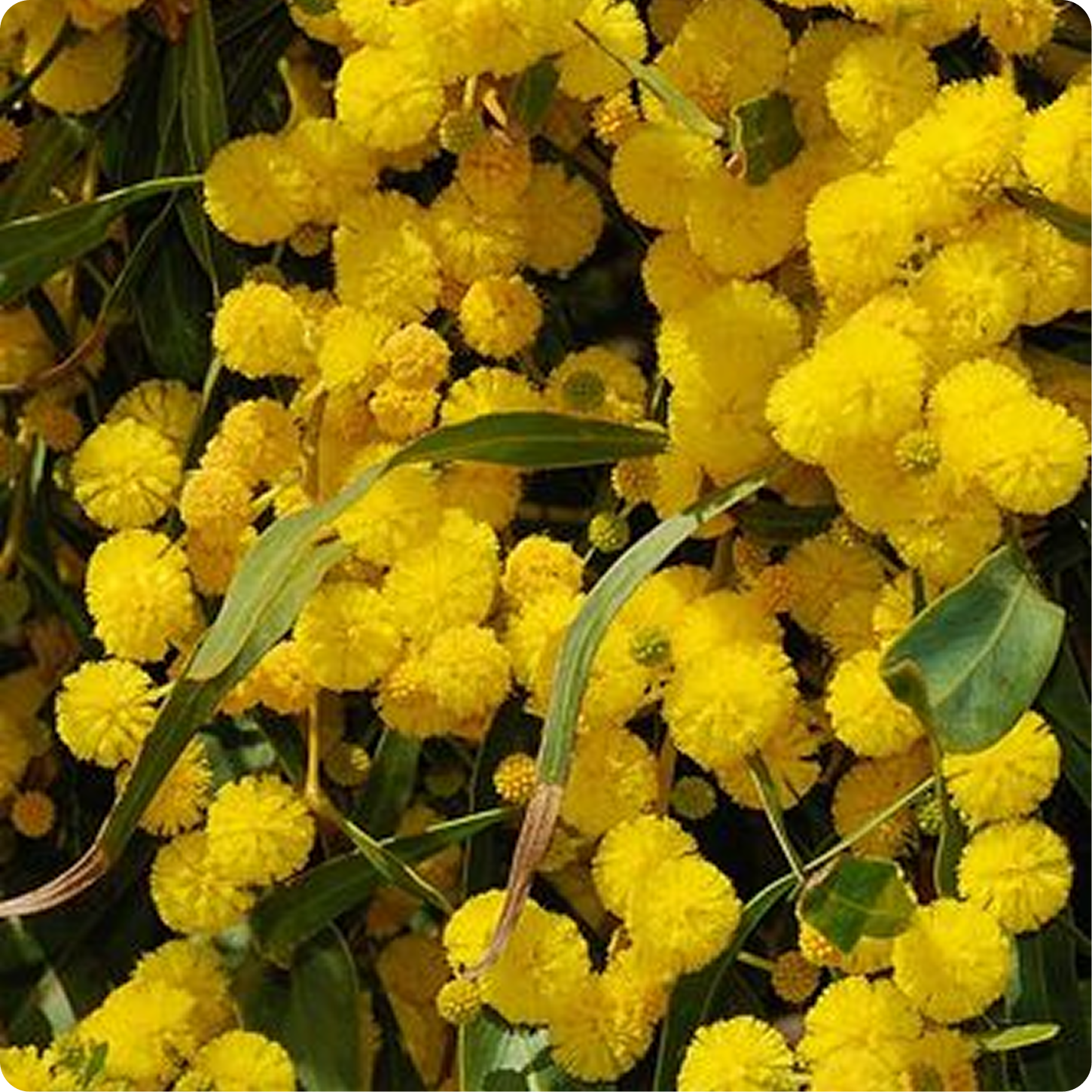
Acacia brumalis is a hardy, attractive acacia growing up to 3 metres. It produces dense foliage that offers shelter for birds and small wildlife, while providing masses of yellow flowers in winter and spring for bees and butterflies. Well-suited to many soil types, thrives in full sun and is drought tolerant once established.
A low maintenance, small bushy shrub perfect for native gardens, wind breaks and habitat.


Acacia daphnifolia has profuse yellow flowers in early winter, attracting pollinators. Adaptable to various soil types and pH levels, it's the perfect pick for anyone aiming to add a WA native plant into their garden.
Acacia daphnifolia roots enrich the soil by fixing nitrogen, fostering a healthier environment for all your garden's inhabitants. A medium shrub to 4 metres, it reshapes itself to fit its home, making any landscape design dream achievable.
You're also creating a haven for birds, pollinators, and other beneficial wildlife. Ideal for screening, wind protection and habitat corridors.


A rounded, bushy shrub growing up to 3 metres. Masses of yellow flowers in spring and long seed pods that resemble a string of beads.
Fast growing, very hardy once established and provides great habitat and food for birds and pollinators. Ideal for screening and inclusion in a habitat corridor.


Enhance your landscape with the Acacia sessilispica, a dense, rounded shrub native to Western Australia. Growing to 3 metres, its pungent green phyllodes and golden flowers create a vibrant display from August to September. This hardy plant thrives in granitic loam and sandy soils, making it a resilient addition to your garden.
The Acacia sessilispica's inflorescences are a visual delight, with sessile spikes densely covered in pale to dark golden flowers. Blooming in late winter to early spring, these yellow blossoms add a burst of colour to any outdoor space.
Ideal for shrubland and mallee communities, Acacia sessilispica is perfect for adding structure and visual interest to gardens. Its angular, glabrous branchlets and glossy black seeds offer a unique aesthetic, while its robust nature ensures it withstands various environmental conditions, making it a versatile choice for any garden design.


Acacia trigonophylla is a multi-branched shrub with an erect habit. Its green branchlets are angled from the stem forming narrow triangular wings, giving it a unique sculptural vibe to your garden.
Yellow flowers through late winter also provides great protection and habitat.


Enchylaena tomentosa, also known as barrier saltbush, is a hardy, low maintenance native shrub perfect for tough conditions, thriving in many soil types, coastal areas and dry landscapes. Growing to 0.5-1m, barrier saltbush is resilient and adds great habitat value to your garden.
It's soft green foliage is complemented by vibrant red and golden berries which attract birds and wildlife to your space. Barrier saltbush is ideal for groundcover, erosion control and habitat.

Beneflore brings life back to the root zone.
Healthy soil is not just something plants grow in. It is a living system — a complex world of minerals, carbon, organic matter, fungi, bacteria, water, air and countless biological interactions happening around the roots.
But many of our soils have very little of that complexity left.
In the sandy soils common across Perth and south-west Western Australia, water and nutrients can move through quickly, organic matter is often scarce, and there may be little of the structure or biological richness that develops naturally in a healthy ecosystem.
Beneflore™ is our attempt to put some of that back.
It is a concentrated, small-batch soil amendment designed to help create a richer, more biologically active root zone — not simply by feeding the plant, but by helping rebuild the environment that plants and soil life depend upon together.
Rewild below ground
When we talk about rewilding soil, we don't mean trying to manufacture untouched natural soil in a bag.
We mean restoring some of the things that healthy soils naturally accumulate over time: carbon, minerals, humus, decomposed organic matter, microbial life and the complex structures that hold water and nutrients close to roots.
Beneflore brings these elements together in one concentrated planting amendment.
Our mature compost is rich, earthy and teeming with microbial life. Worm castings contribute further biological and organic complexity. Kelp and other organic inputs provide food and resources for the soil community, while mineral ingredients broaden the physical and nutritional environment.
And beneath all of this is the structural foundation.
Built on Hydrophil™
Beneflore contains Hydrophil™, our concentrated root-zone matrix made from biochar, spongolite and kaolin clay.
Hydrophil is designed to add the porous carbon and fine mineral surfaces that poor sandy soils are naturally short of. These materials help the root zone hold water and nutrient ions while creating a more complex physical habitat for microbial life.
In Beneflore, that structure becomes the foundation for something richer.
We combine it with mature compost, worm castings, organic matter, minerals and living biology to create a root zone that is not only better able to hold water and nutrients, but better equipped to support the biological processes that help make those nutrients available to plants.
More than fertiliser
Beneflore isn't primarily about delivering a quick dose of plant food.
It is about building soil that works better.
A living root zone can capture nutrients, cycle organic matter, form relationships with plant roots and gradually create conditions that support healthier plant growth.
That is why Beneflore contains ingredients serving several different roles:
-
Structure and habitat — Hydrophil™ provides biochar, spongolite and kaolin clay to create a more complex root-zone matrix.
-
Living organic matter — mature compost and worm castings introduce humus, carbon and biologically active material.
-
Biology — beneficial microorganisms and mycorrhizal fungi help establish a more diverse soil community.
-
Food for soil life — kelp and organic inputs provide resources for biological processes.
-
Mineral diversity — rock minerals contribute a broader range of elements to the soil environment.
-
Gentle plant nutrition — nutrients are present, but within a much broader philosophy of feeding and rebuilding the soil.
Made in small batches
Beneflore is not an inert bag of minerals.
Because it contains living compost and biological ingredients, we make it in small batches and accept that there will be natural variation in its colour, texture, moisture and aroma.
That variation is part of the product.
We want Beneflore to look, feel and smell like what it is: a rich, earthy concentration of the ingredients that help bring a depleted root zone back to life.
What's in Beneflore?
Hydrophil™ root-zone matrix
Biochar · Spongolite · Kaolin clay
Plus
Mature compost · Worm castings · Kelp · Rock minerals · Beneficial microbes · Mycorrhizal fungi
How to use
Beneflore is a concentrated planting-hole amendment, not a conventional bulk compost or potting mix.
Mix approximately 1 part Beneflore with 3–4 parts existing soil or planting backfill and use this amended soil through the root zone when planting.
For very poor sandy soils, use the richer end of the range. In better existing soil, a smaller amount may be sufficient.
Mix thoroughly through the backfill rather than placing Beneflore as a concentrated layer beneath the plant.
Rewild your soil
Above ground, rewilding might mean planting local species and rebuilding habitat.
Below ground, the same idea begins with restoring complexity.
Structure. Carbon. Minerals. Organic matter. Fungi. Bacteria. Water. Nutrients. Roots.
Beneflore brings those pieces together to help create something greater than any one ingredient alone:
a living root zone.
4 L concentrated living soil amendment


Eucalyptus redunca (subsp. redunca), or Black Marlock grows into a small mallee of 4 metres so perfect in a small garden. It has creamy yellow flowers from spring to summer which support all the pollinators.
The foliage of this eucalyptus is dull green and slightly blue. The buds are long , narrow and horn-shaped. it grows in sandy soils over laterite and coastal areas.


Acacia meisneri, commonly known as the Blue Wattle. This eye-catching plant features vibrant yellow flowers and distinctive bluish-green foliage. Blooming in late winter to early spring, it's timed perfectly to attract pollinators and brighten your garden.
The Blue Wattle thrives in a variety of soil types, from sandy to loamy. It adapts easily, fast growing either as a small, charming tree or a dense, multi-stemmed shrub.
Acacia meisneri improves environmental health and beautifies spaces. It fixes nitrogen in the soil, its drought resistance also makes it suitable for landscaping, promoting a sustainable, water-efficient garden. Whether used as a natural screen or a decorative hedge, the Blue Wattle serves a dual purpose, enhancing both garden aesthetics and ecosystem health.


Eucalyptus kruseana, also known as the bookleaf mallee, is a unique and compact eucalyptus with striking silvery-blue, round foliage and decorative greenish yellow flowers. It grows as a straggly multi-stemmed mallee to 3.5m and has bark that sheds in ribbons. Adult leaves rarely form in the crown so it has only its juvenile leaves which give it it's unique character.
It has a sculptural form making it a favourite for florists and landscapers alike. Great in smaller gardens and easy to care for.

Melaleuca huegelii, or Chenile Honey-Myrtle, is a dense, medium shrub growing up to 5 metres. It has small leaves crowded against the stems and large white bottlebrush like flowers which attract many pollinators. Flowering occurs in early summer.


Eucalyptus utilis, commonly known as Coastal moort, is a small, hardy mallee growing from 2-6m. It has a short trunk, branches with a spreading habit, smooth grey bark that peels off in ribbons revealing pale coppery bark beneath.
In late spring to summer it produces creamy white flowers that attract birds, bees and other pollinators. Adult leaves are thick, a shade of glossy olive green on both sides, egg-shaped to lance-shaped.
Eucalyptus utilis is highly tolerant of coastal winds, poor sandy soils, and drought, making it an ideal choice for coastal gardens, shelterbelts, wind breaks and habitat corridors.


Acacia cyclops, commonly known as coastal wattle or red-eyed wattle, is a hardy dome shaped shrub mostly found in coastal regions. It usually grows to a height of 4 metres but can get taller.
Its easily recognised by its bright yellow flowers, which are produced over a long time, from winter up until summer, and distinctive seed pods filled with seeds surrounded by a fleshy red aril - hence the name 'red-eyed'.
Acacia cyclops loves Perth sandy soils, where it is valued for its resilience and ability to improve soil fertility through nitrogen fixation.

Templetonia retusa, or cockies tongues, is a multi-branched rounded shrub with grey green leaves and an up right habit, growing to 2 metres. It has large red pea-like flowers over a long time, seen in winter through to spring.
Templetonia retusa is an attractive and hardy plant that grows in a wide range of soil types along the coast line from Shark Bay into South Australia, including the Perth area.


Astartea scoparia is found growing from Lancelin down to Albany in sandy, loamy soils. It's also found along winter wet depressions, watercourses and granite outcrops.
It grows as a small open shrub with a weeping arching branches, from 1-2 metres. It becomes covered in small white, wax-like flowers in Spring which last for months, also attracts bees and butterflies. It has deep evergreen fine, feathery aromatic foliage giving it an elegant form.


Common Wallaby Grass, Rytidosperma caespitosum, is a native tufted grass that reaches up to 90cm. It is a deep-rooted winter growing grass, improving soil structure. It can tolerate a wide range of soil types and diverse habitats.
Native grasses provide habitat for local insects, supporting butterflies and other pollinators throughout their life cycles. The seed heads provide food for birds. They also offer shelter and nesting material for small birds and reptiles.


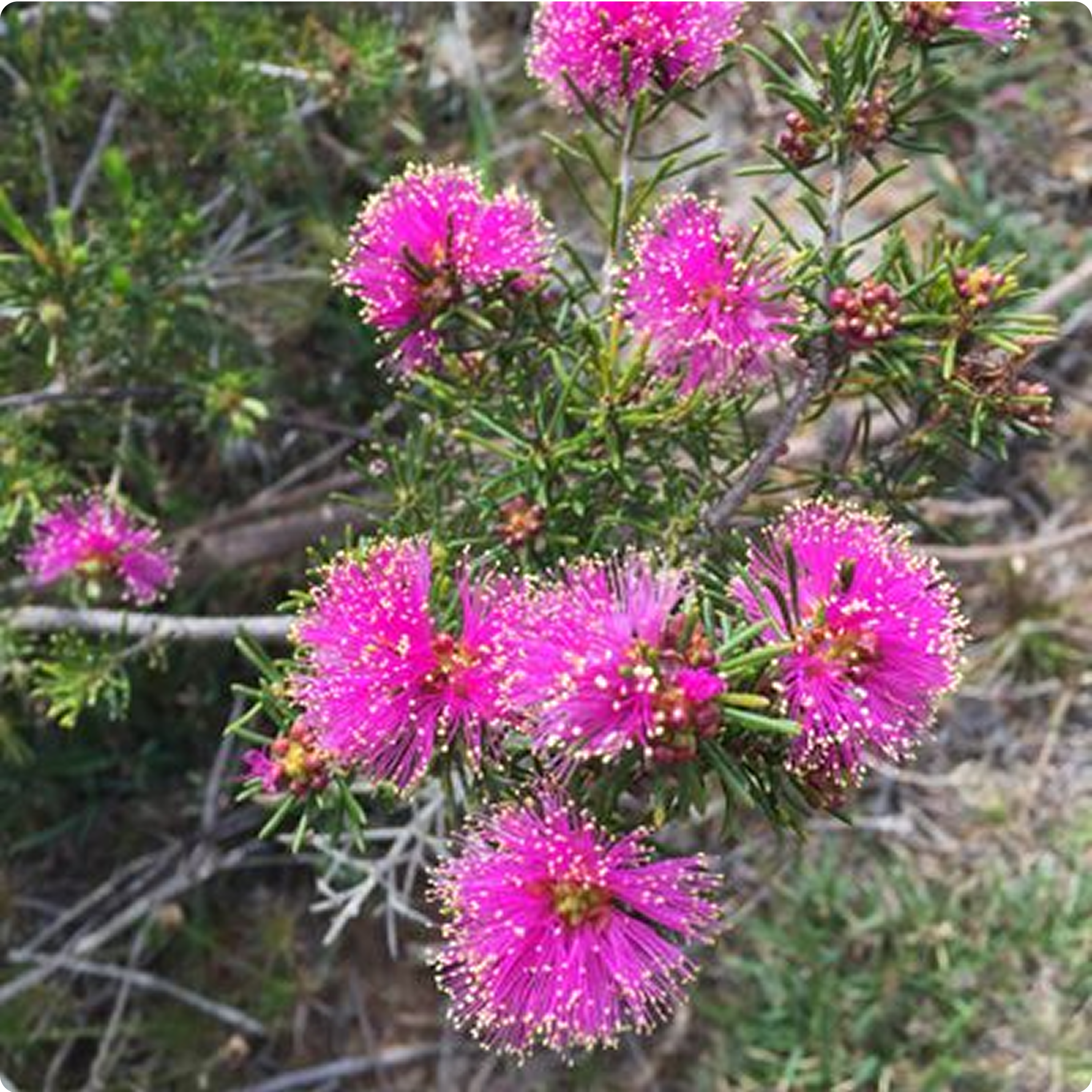
Discover the splendid Crimson Kunzea (Kunzea baxteri), a natural spectacle. Ideal for stand alone displays or screening, it's your tool for transforming any space into an enchanting landscape.
Kunzea baxteri flourishes in well-drained soils, full or partly shady position, perfect for Perth environments. Beyond its visual appeal, it promotes environmental well-being, fitting effortlessly into your garden.
Grows to 3m erect shrub, grey-green foliage and crimson profuse flowers clustered in 'bottlebrush' arrangement.


Eucalyptus drummondii, or Drummond's gum, is a compact and elegant mallee making it an excellent choice for Perth gardens. Usually growing to 3-7m, it can be grown in a small garden or several planted to fill a sunny spot.
It features smooth, mottled bark and attractive, blue-grey foliage, complemented by creamy/white flowers that start blooming in spring. This species is well suited to Perth's sandy soils and climate, thriving in full sun and drought tolerant once established.
Compact and attractive, Eucalyptus drummondii is ideal for native gardens, habitat planting or as a feature tree.


Banksia menziesii, commonly known as firewood banksia, is a small tree or large shrub, found in the local Perth area from Geraldton down to Mandurah. It's well adapted to our sandy soils and grows from 2 to 6 metres, loves a sunny location and well-draining soil.
It has long serrated, leathery green/grey leaves but it's prized for it's large cylindrical flower spikes that bloom from Autumn through winter. They are red, pink, orange and rarely yellow, and highly attractive to nectar-feeding birds. Flowers are followed by distinctive woody seed cones.
Showing 20/96
NextOur community @wildbosky